
The War of the Worlds
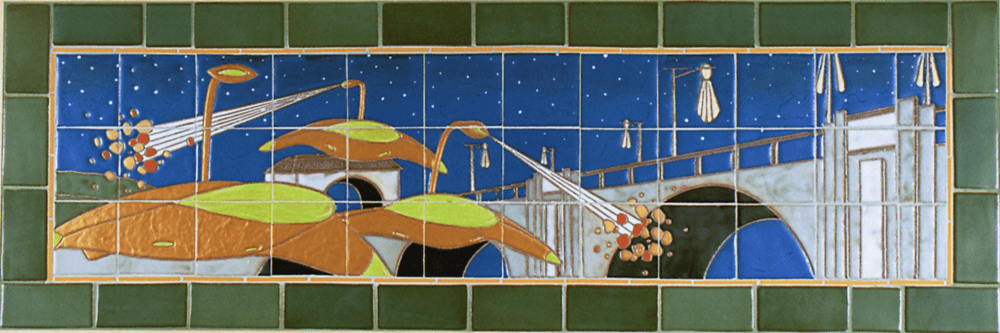
On the evening of October 30, 1938, the Mercury Theatre on the Air radio show, produced by Orson Welles and John Houseman, began its broadcast with “reporting” by the fictional character Carl Phillips, accompanied by a fictional Princeton University Astronomer named Professor Pierson.
“Ladies and gentleman, this is Carl Philips again, at the Wilmuth Farm, Grovers Mill, New Jersey…. Well, I hardly know where to begin, to paint for you a word picture of the strange scene before my eyes, like something out of a modern Arabian Nights. Well, I just got here. I haven’t had a chance to look around yet. I guess that’s it. Yes, I guess that’s the …thing, directly in front of me, half buried in a vast pit. Must have struck with terrific force. The ground is covered with splinters of a tree it must have struck on its way down. What I can see of the …object itself doesn’t look very much like a meteor, at least not the meteors I’ve seen. It looks more like a huge cylinder…”.
Welles, who would go on to be a famed actor and director, narrated and performed an adaptation of H.G. Wells’ classic novel, The War of the Worlds. What ensued was panic as listeners who had missed the beginning of the broadcast thought extraterrestrial beings were invading New Jersey. Residents of Grovers Mill, approximately 5 miles from Princeton, were particularly panicked, and the fire chief of nearby Cranbury, New Jersey received dozens of reports and phone calls. The story captivated newspaper headlines following the broadcast and caught the attention of noted Princeton University psychology professor Hadley Cantril. Cantril studied the effect of the broadcast and published his findings in The Invasion from Mars: A Study in the Psychology of Panic. According to his findings, an estimated 6 million listeners tuned into the broadcast, 1.7 million of them took the “report” as fact and 1.2 million panicked as a result.
Media
- War of the Worlds radio broadcast recording (WNYC Studios’ Radiolab)
Books
- The Invasion from Mars: A Study in the Psychology of Panic by Hadley Cantril (The Internet Archive)
- The Complete War of the Worlds: Mars’ Invasion of Earth From H.G. Wells to Orson Welles (Princeton Public Library)
- Broadcast Hysteria: Orson Welles’s War of the Worlds and the Art of Fake News by Brad A. Schwartz (Princeton Public Library)
- Spooked!: How A Radio Broadcast and The War Of The Worlds Sparked the 1938 Invasion of America by Gail Jarrow (Princeton Public Library)
Articles
- “Princeton to Investigate Hysteria From Radio Play” (Princeton Herald, Volume 16, Number 8, 23 December 1938)
- “Welles’ Broadcast Aids Psychologists: Research Department Wil Study Incident – Cantril to Talk on Episode at 10:30” (Daily Princetonian, Volume 63, Number 126, 2 November 1938)
- “Cantril Directing Hysteria Analysis: Professor Heading Investigation of Radio Public’s Research to Recent Martian Invasion” (Daily Princetonian, Volume 63, Number 162, 6 January 1939)
- “Wells and Welles Films to be Shown at Museum” (Town Topics, 19 October 1988)
- “News of the Theatres Orson Welles Broadcast to be Recreated Sunday” (Town Topics, 26 October 1988)
- “Professor Hadley Cantril Studied Hysteria After ‘War of the Worlds’” by Elyse Graham (Princeton Alumni Weekly, 24 September 2021)
- “Radio Listeners in Panic, Taking War Drama as Fact” (The New York Times, 31 October 1938)
- “Excerpts From the ‘War’ Broadcast” (The New York Times, 1 November 1938)
- “War’ broadcast studied” (The New York Times, 20 December 1938)
- “The Infamous War of the Worlds Broadcast was a Magnificent Fluke” by A. Brad Schwartz (Smithsonian Magazine, 6 May 2015)