
The Spitzer Space Telescope and the Rittenhouse Orrery
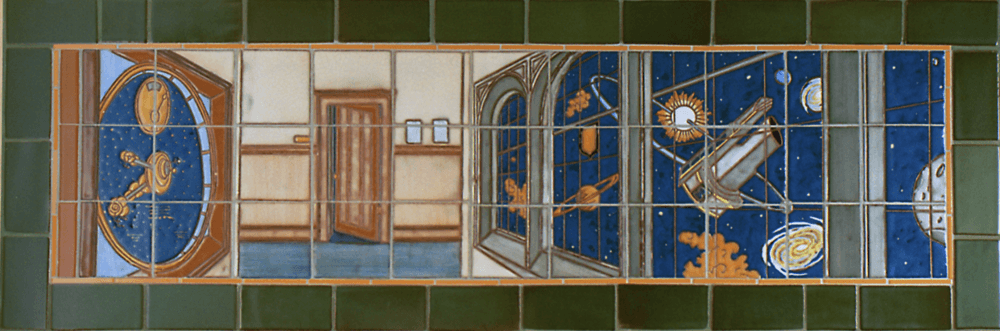
Katherine Hackl, the artist of the Princeton Stories tiles, describes the “Spitzer Space Telescope and the Rittenhouse Orrery” tile as a representation of “where we are now and where we began.”
Orreries were once an invaluable tool for the teaching of science, representing the movements of the planets around the sun in our solar system. The most famous apparatus was created for the Earl of Orrery (Ireland) in 1713, which is where these tools received their name. The orrery depicted in this tile was the first of two made by David Rittenhouse, a Pennsylvania clockmaker. It was purchased by John Witherspoon in 1771 and was promptly displayed in Princeton’s Nassau Hall. The Rittenhouse Orrery was damaged (and later repaired) during the American Revolution when Nassau Hall was occupied by soldiers. Over a century later, it was exhibited at the 1893 Chicago World’s Fair, then was lost for about 50 years until it was rediscovered in the basement of McCosh Hall. It has since been restored and is part of the Princeton University Art Museum.
Lyman S. Spitzer, Jr. became the Director of the Halsted Observatory at Princeton University in 1947 and later, a Charles A. Young professor of Astronomy and Chair of the Astronomy Department where he “pioneered calculations of the temperature of rare gasses in interstellar space.” With the backing of the United States Atomic Energy Commission, Spitzer developed Project Matterhorn at Forrestal Research Campus in 1951 to study “basic plasma physics and the possibilities of controlled thermonuclear power.”
The Space Infrared Telescope Facility (SIRTF) was launched in 2003 as part of NASA’s Great Observations Program. It was preceded by the Hubble Space Telescope, The Compton Gamma Ray Observatory and the Chandra X-Ray Observatory. Before the mission ended in 2020, it had discovered a ring on Saturn and detected light from a planet outside of our solar system. In 2003, a few months after it was launched, SIRTF was renamed the Spitzer Space Telescope in honor of Lyman S. Spitzer, Jr. who conceived the idea of using a telescope in space to detect interstellar gasses.
Websites
- Orrery, 1770 (Princeton University Art Museum)
- Spitzer Space Telescope (NASA)
- Spitzer Space Telescope (California Institute of Technology)
- Lyman Spitzer Jr. (California Institute of Technology)
- Lyman Spitzer and the Space Telescope (The American Museum of Natural History)
Articles
- “The Rittenhouse Orrery” (The Princeton University Library Chronicle, Vol. 12, No. 3, Spring 1951 via JSTOR)
- “The Rittenhouse Orrery” by April C. Armstrong (Mudd Manuscript Library Blog, 23 December 2014)
- Stories of Penn Scientists: David Rittenhouse by Erica K. Brockmeier (Penn Today, 31 May 2019)
- “Orrey to be Shown” (Town Topics, 18 January 1959)
- “Celebrating Lyman Spitzer, the father of PPPL and the Hubble Space Telescope” (Princeton University, 24 October 2013)
- “Long Teaching Career Ended by Retirement” (Princeton Herald, Volume 40, Number 73, 26 June 1963)
- “Spitzer Wins NASA Prize” (Daily Princetonian, Volume 96, Number 124, 22 November 1972)
- “Astrophysicists Lobby for Space-Based Telescope” by Jonathan Coppersmith (Daily Princetonian, Volume 101, Number 47, 11 April 1977)
- “Spitzer, father of Space Telescope” by Jacquelyn Savani (Princeton Weekly Bulletin, Volume 79, Number 22, 9 April 1990)
- “Telescope Designer Reacts to Latest Repairs” by Carolyn Bradner (Daily Princetonian, Volume 117, Number 130, 9 December 1993)
- “Astrophysicist Spitzer Dies at 82; Led Development of Hubble Telescope” by Mary-Jo Valentino (Daily Princetonian, Volume 121, Number 39, 2 April 1997)
- “Major New Space Telescope Named After Princeton Astronomer” by Steven Schultz (Princeton Weekly Bulletin, Volume 93, Number 13, 12 January 2004)
Books
- The Rittenhouse Orrery: Princeton’s Eighteenth-century Planetarium, 1767-1954. A Commentary on An Exhibition Held in the Princeton University Library by Howard C. Rice (Princeton Public Library)