
Black Squirrels Above Nassau Hall
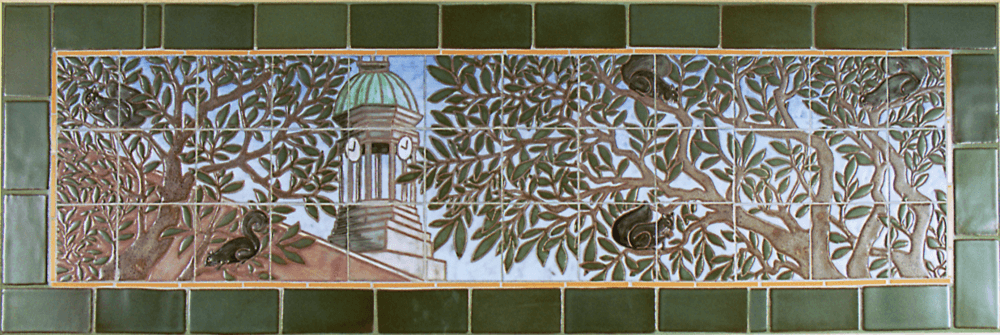
At the time of its construction in 1756, Nassau Hall was the largest stone building in the colonies and served as the new home of The College of New Jersey, now Princeton University, after its move from Newark. In the 1770s, the American Revolution swept through the campus. Upon hearing that patriots in Boston had dumped tea in the Boston Harbor, students took all the tea from the College’s storeroom and private stashes and had their own “tea party,” burning the tea in a large bonfire in front of Nassau Hall. When war broke out, the building was used as a barracks and hospital, changing hands numerous times before the end of the revolution. The building served as the temporary home of the Continental Congress in the summer of 1783. It is also where General Washington received the thanks of the Congress for winning the war; the first meeting of the New Jersey Legislature convened at Nassau Hall; and, it was the location of the inauguration of the first governor of New Jersey.
The appearance of Nassau Hall has changed over the centuries. Over the years, it has been home to university classrooms, dormitories, a library and offices. The exterior of the building has also been damaged and repaired from war and from two fires in 1802 and 1855. Today, Old Nassau is an ivy-covered reminder of Princeton’s place in the American Revolution. Nassau Hall is seen in this tile along with the unusually black squirrels that are common on Princeton University’s campus and have long been a topic of conversation and lore.
Books
- Nassau Hall: Princeton University’s National Historic Landmark by William K. Selden (Princeton Public Library)
- Princeton Sketches: the Story of Nassau Hall by George Riddle Wallace (Princeton Public Library)
- Nassau Hall, 1756-1956 by Henry L. Savage (Princeton Public Library)
- Inner Sanctum: Memory and Meaning in Princeton’s Faculty Room at Nassau Hall by Karl Kusserow (Princeton Public Library)
Websites
- Nassau Hall – Princetoniana (Princeton University)
- Green Oval Tour: A Snapshot of 18th Century Princeton (The Historical Society of Princeton)
- Nassau Hall, Princeton University (National Register of Historic Places)
- Nassau Hall, Princeton, N.J., June 30, 1783—Nov. 4, 1783 (Office of the Historian, Shared Knowledge Services, Bureau of Administration, United States Department of State)
- Nassau Hall (Crossroads of the American Revolution)
- Nature Walks with Henry Horn by Jared Flesher (Princeton University, 16 July 2018)
Articles
- “The Burning of Nassau Hall, March 6, 1802” (Princeton Standard., Volume I, Number 9, 19 October 1859)
- “Memorial Tablet on Nassau Hall” (Alumni Princetonian, Volume 3, Number 14, 22 October 1896)
- “Library Divulges Tale Of Patriotic Cannon Ball” (Daily Princetonian Alumni Day Special, Volume 64, Number 12, 22 February 1939)
- “New Bell for Nassau Hall” (Daily Princetonian, Volume 74, Number 98, 31 May 1950)
- “Black Squirrels Puzzle Nature Buffs” by John Wilheim (Daily Princetonian, Volume 96, Number 108, 20 October 1972)
- “The Best and The Bushiest” by David Groff (Daily Princetonian, Volume 101, Number 97, 14 October 1977)
- “Ask Dr. Blaine” (Daily Princetonian, Volume 123, Number 4, 4 February 1999)
- “Princeton Makes List of Squirrel-Obsessed Colleges” (Daily Princetonian, Volume 137, Number 75, 26 September 2013)